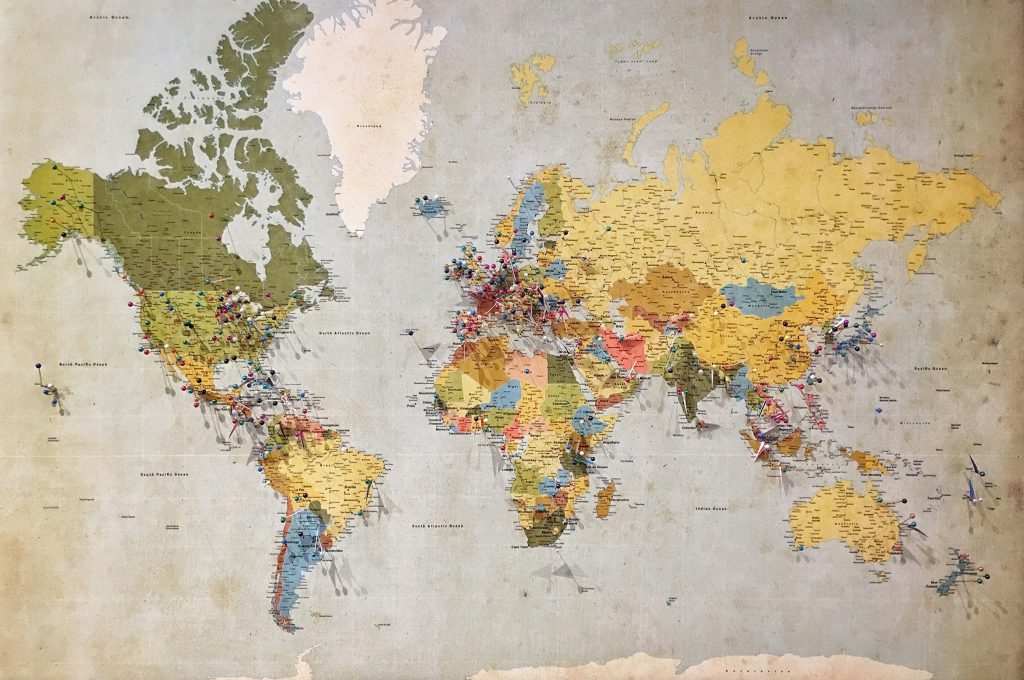
Why Geography Is the Missing Piece in Your Student’s History Education
Ask most high school students to name the factors that shape world history and politics, and you’ll get a familiar list: wars, leaders, economies, ideologies. Geography rarely makes the cut. That’s a problem, because geography isn’t just the backdrop to human history. In many ways, it’s the engine.
That’s the argument journalist and author Tim Marshall makes in two of the most important books I’ve encountered in years of teaching history and current events. And it’s the argument that anchors two of my favorite courses to teach.
The Book That Establishes the Importance of Geography
Prisoners of Geography is Marshall’s initial text. It is a tour of the world through the lens of physical geography and its political consequences. Why has Russia always been paranoid about its borders? Why does China’s foreign policy revolve so heavily around its coastline? Why have certain regions of the world been fought over for centuries while others have not? Marshall’s answer, again and again, comes back to mountains, rivers, plains, and coastlines. These are the physical facts of the earth that no army, ideology, or treaty has ever fully overcome.
The book is wonderfully readable. Marshall has a journalist’s instinct for clarity and he brings a historian’s appreciation for the long view. By the time a student finishes it, they have a new way of looking at a map, and at the news.
This is the text I assign in my fall course, Modern Geopolitics 1. We move through one chapter a week, using Marshall’s framework as a way to think about the country or region he writes about. I add up-to-date videos and articles, and students then have a whole new vocabulary for thinking about power and geography that they simply didn’t have before.
Taking It Further
The Power of Geography is Marshall’s follow-up, and it’s a look into the future. Where Prisoners laid out the foundational argument, Power applies it to ten regions and territories that are shaping the 21st century. This is the text for my spring course. Part 2 is a natural extension of everything we built together in the first semester. By the time students reach The Power of Geography, they’re not just reading Marshall. They’re reading with him, and sometimes against him.
Why I Encourage Students to Argue With Marshall
Here’s something I tell every student at the start of both courses: Tim Marshall is a smart, knowledgeable, and genuinely compelling writer. He is also one person, with one perspective, and you are allowed to disagree with him.
That’s not a disclaimer. It’s an assignment and it’s a sort of permission. Students are often handed a textbook and told to read and regurgitate. But that is not what will be expected of them as they grow.
Learning to argue with a credible author is one of the most valuable academic skills a student can develop. It requires them to understand the argument well enough to push back on it, to find the places where the evidence is thin or the perspective is narrow, to ask whose voices are missing from the analysis. Marshall writes largely from a Western, journalistic vantage point, and that’s worth noticing. When we look critically at his framing of certain regions or conflicts, students begin to see that even excellent sources have blind spots. And that’s a lesson that applies far beyond these two books. This is not passive consumption. This is active, critical engagement with ideas.
What Students Take Away
One of the comments that has stayed with me longest came from a student who had completed both courses. They said that what they understood now, in a way they hadn’t before, was two things: the importance of the lines drawn on a map by other people, and the remarkable significance of navigable waterways. And that it had permanently changed how they take in the news.
I was ecstatic to hear this. With that student, I reached a goal. Not memorization. Not coverage. That student, and many others left the class with a new lens that they carry with them long after the course is over, into every headline, every election, every conflict they encounter for the rest of their lives.